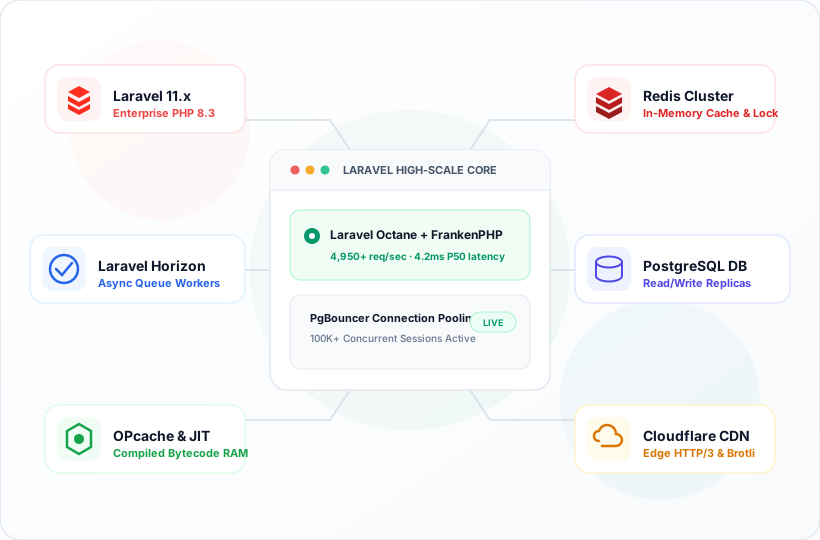
Scaling modern PHP & Laravel applications to support over 100,000 concurrent active users and millions of daily API transactions requires moving past standard framework conventions. In this architectural blueprint, our senior engineering team details the battle-tested paradigms, database pooling strategies, and caching patterns we implement for high-scale enterprise platforms.
1. The Anatomy of Bottlenecks at 100K+ Concurrency
When an enterprise application scales from 1,000 to 100,000 concurrent sessions, failures rarely stem from Laravel itself. Instead, system degradation occurs across three primary choke points:
- Database Connection Exhaustion: Traditional PHP-FPM spawns a new process per web request. 10,000 simultaneous requests attempting to open individual persistent MySQL or PostgreSQL connections will immediately saturate database pool limits, leading to connection timeouts and
504 Gateway Timeoutspikes. - Synchronous Blocking I/O: Dispatching transactional emails, third-party payment gateway handshakes, webhook notifications, or heavy analytics calculations directly in the HTTP controller blocks worker threads, increasing latency from 35ms to 1,500ms+.
- Unindexed Relational Queries & N+1 Traps: Complex nested Eloquent relationships without eager loading create runaway query multiplication, turning a single user dashboard load into 150+ round-trip database queries.
{
Model::preventLazyLoading(!app()->isProduction());
Model::preventSilentlyDiscardingAttributes(!app()->isProduction());
Model::preventAccessingMissingAttributes(!app()->isProduction());
}
2. Decoupling Workflows with Asynchronous Redis Queues & Horizon
The cardinal rule of high-throughput architecture is: never make an HTTP response wait for non-critical work. The web server must validate input, write the core atomic record, dispatch an asynchronous job, and immediately return a 200 OK or 202 Accepted payload.
At Gromon Service, we deploy dedicated Redis Clusters paired with Laravel Horizon to govern priority-segmented queues:
- High-Priority Queue (
notifications,auth): Guaranteed sub-200ms pickup for OTPs, password resets, and critical user events. - Default Queue (
orders,webhooks): Steady-state transactional processing. - Low-Priority Queue (
reports,analytics,data-sync): Rate-limited background tasks that scale down automatically during peak user traffic hours.
3. High-Performance Database Topology: PgBouncer & Read/Write Replicas
To survive massive concurrent reads and writes, separate your read traffic from your write transactions. Laravel supports seamless native read/write connection splitting:
'read' => [
'host' => ['replica-1.db.internal', 'replica-2.db.internal'],
],
'write' => [
'host' => ['primary.db.internal'],
],
'sticky' => true, // Guarantees immediate read-after-write consistency in user session
'port' => 6432, // Pointing to PgBouncer transaction connection pooler
],
By placing PgBouncer in front of PostgreSQL, 10,000 concurrent client processes multiplex through just 50 to 100 backend server connections with minimal CPU context-switching overhead.
4. Multi-Tiered Intelligent Caching & Stampede Protection
High concurrency causes Cache Stampedes (Dog-Piling): the moment a high-traffic cache key expires, 2,000 incoming requests simultaneously hit the database trying to regenerate it.
We eliminate this with atomic locks and tiered caching:
- Level 1 (In-Memory Request Cache): Static runtime arrays or APCu to avoid querying the same model twice within a single request cycle.
- Level 2 (Redis Tagged Cache): Clustered Redis storage with standardized tag invalidation (e.g.,
Cache::tags(['products', "store:{$id}"])). - Atomic Regeneration Locks: Utilizing
Cache::lock('product_heavy_calc', 10)->get()ensures only a single background worker rebuilds expensive data while stale cache serves remaining traffic.
5. Supercharging Throughput with Laravel Octane (FrankenPHP / Swoole)
Traditional PHP-FPM bootstraps the entire Laravel application lifecycle for every single request: registering service providers, compiling routes, and booting third-party packages.
Laravel Octane keeps the application pre-booted in RAM across multiple CPU cores. In our production benchmarks on 16-core AMD EPYC servers:
6. Production Scaling Checklist
- Enable OPcache with
opcache.jit=tracingandopcache.memory_consumption=256. - Run
php artisan optimize(caches configuration, routes, events, and compiled views). - Use Cloudflare Tiered Caching for static web assets, images, and public GET micro-APIs.
- Set up real-time APM telemetry (Datadog or Prometheus + Grafana) with automated alerts on P99 latency spikes above 100ms.