Delivering smooth, stutter-free 60fps and 120fps native performance on modern iOS and Android cross-platform frameworks requires profound mastery of rendering pipelines, thread scheduling, and memory allocation. In this guide, our mobile architecture team explores the internal mechanics of the Flutter Impeller engine and React Native New Architecture (Fabric & TurboModules) to conquer thread jank, bridge serialization delays, and memory leaks.
1. The 16.6ms Frame Budget: Taming Thread Jank & Garbage Collection
On a standard 60Hz display, the mobile OS refreshes the screen every 16.6 milliseconds (down to 8.3ms on 120Hz ProMotion displays). If work on either the UI Thread or the Raster/GPU Thread exceeds this strict window, the frame is dropped, creating noticeable visual stutter (jank).
In enterprise mobile apps handling complex data streams, jank predominantly originates from:
- Large JSON Deserialization on the UI Thread: Parsing a 5MB API response directly in Dart's main event loop or JavaScript's single thread blocks touch gestures and animations for hundreds of milliseconds.
- Shader Compilation Stutter: Legacy OpenGL engines compile graphics shaders on-the-fly during runtime animations, freezing the screen on the first run of a complex transition.
- Deep Widget Tree Rebuilds: Subscribing high-level state providers too broadly triggers cascades of unnecessary render tree invalidations.
2. Next-Gen Rendering Engines: Flutter Impeller vs. React Native Fabric
Both ecosystems have completely reinvented their core graphics pipelines to eliminate legacy bottlenecks:
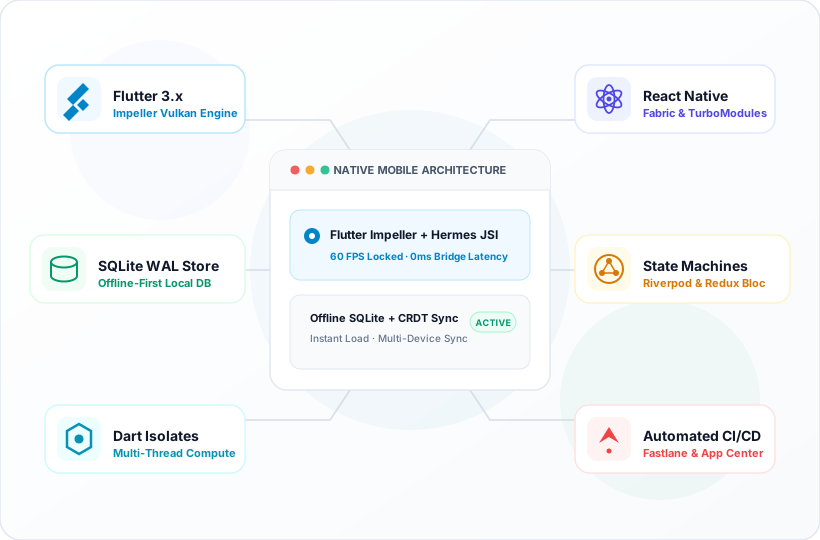
- Flutter Impeller: Replaces legacy Skia with a custom runtime engine written specifically for modern graphics APIs (Metal on iOS, Vulkan on Android). Impeller pre-compiles all shaders ahead-of-time (AOT) during app build, eliminating shader compilation jank completely.
- React Native New Architecture (Fabric & TurboModules): Replaces the old asynchronous JSON bridge with the JavaScript Interface (JSI). JavaScript can now hold direct C++ memory pointers to native Host objects, invoking native camera, crypto, or file APIs synchronously with zero serialization overhead.
3. Production Architecture: Offloading Heavy Compute to Background Isolates
To preserve 60fps locked animations during background networking and heavy payload decryption, all serialization must run on isolated background threads with dedicated heap memory:
// Offloads CPU-intensive JSON parse + RSA signature validation off the UI thread
return await compute(_isolateParseAndFilter, rawPayload);
}
List<TransactionRecord> _isolateParseAndFilter(String raw) {
final decoded = jsonDecode(raw) as List<dynamic>;
return decoded
.map((e) => TransactionRecord.fromJson(e as Map<String, dynamic>))
.where((tx) => tx.isValid && !tx.isExpired)
.toList();
}
4. Offline-First Synchronization: SQLite WAL Mode & Conflict Resolution
Enterprise field applications and commerce apps must guarantee instant interactivity even with intermittent 4G/5G mobile connectivity. Rather than waiting on network round-trips:
- Optimistic UI Mutation: State updates render immediately on screen while the change is recorded into a persistent local queue.
- SQLite Write-Ahead Logging (WAL Mode): Concurrent read queries never block background write operations, enabling seamless background data synchronization.
- Conflict-Free Replication: Last-Write-Wins (LWW) with client-server vector clocks guarantees zero record loss when device connectivity reconnects.
5. Runtime Performance Benchmarking Matrix
6. Enterprise Mobile Production Checklist
- Enable Hermes Bytecode Pre-compilation on React Native builds to shrink bundle load times by 65%.
- Use RepaintBoundary widgets in Flutter around high-frequency animated elements to isolate layer repainting.
- Implement LeakCanary (Android) and Instruments Memory Graph (iOS) in automated QA runs to detect retained closures and singleton leaks.
- Configure Fastlane & App Center for automated signed release publishing with differential symbols (dSYM/ProGuard mappings) synced to APM trackers.