Foundation Large Language Models (LLMs) like GPT-4 and Claude 3.5 possess immense reasoning capabilities, yet they remain fundamentally ungrounded in your organization's private corporate knowledge. Retrieval-Augmented Generation (RAG) bridges this chasm by dynamically injecting proprietary enterprise data into the LLM context window—all while enforcing strict privacy shields and zero data retention guarantees.
1. Why Standard LLM Fine-Tuning Fails in the Enterprise
Many organizations assume that fine-tuning an open-source model is the best way to incorporate internal manuals, policies, and contracts. In practice, fine-tuning exhibits severe enterprise limitations:
- Knowledge Decay: Updating documentation requires expensive, repetitive model retraining cycles.
- Hallucination Risks: Fine-tuned parametric memory still invents citations and misquotes contract terms with high confidence.
- Lack of Access Control: Once data is baked into weights, you cannot enforce Role-Based Access Control (RBAC). An intern could prompt the model into revealing executive board minutes or private salary bands.
RAG completely separates reasoning capability from information retrieval, making enterprise knowledge auditable, instantaneous to update, and strictly permission-gated.
2. The Enterprise RAG Lifecycle: Architecture Deep Dive
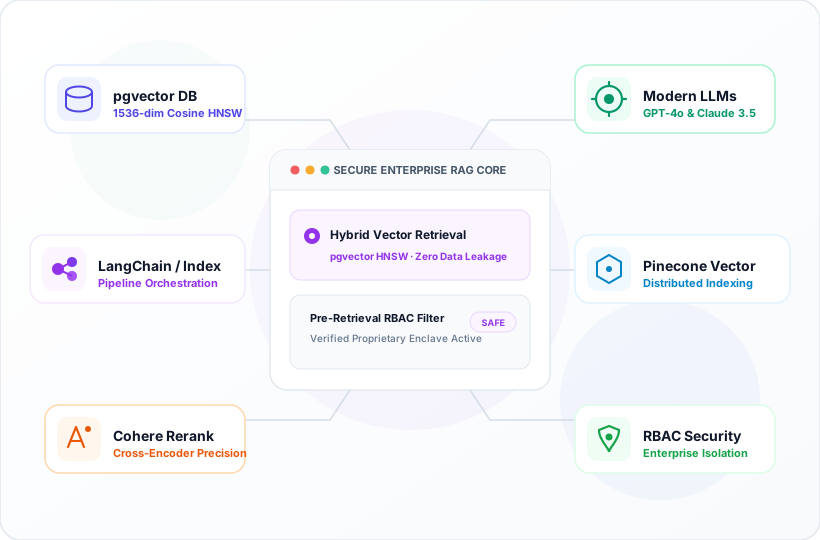
A production RAG system is a multi-stage data engineering pipeline consisting of six discrete phases:
Pipeline Architecture Phases:
- Document Ingestion & Parsing: Extracting clean text from unstructured sources (PDFs, Confluence pages, Markdown, OCR scans).
- Structure-Aware Semantic Chunking: Splitting text based on document hierarchy and sliding window overlaps (512 to 1024 tokens with 15% overlap) to prevent losing sentence context.
- Dense Vector Embedding Generation: Passing chunks through state-of-the-art embedding models (such as
text-embedding-3-largeor open-sourceBGE-Large) to generate 1536+ dimensional coordinates. - Vector Indexing: Storing vectors with metadata in PostgreSQL with
pgvector(HNSW indexing) or Pinecone. - Hybrid Retrieval (Dense + Sparse BM25): Combining semantic similarity search with exact keyword matching via Reciprocal Rank Fusion (RRF).
- Context Re-Ranking & Prompt Grounding: Filtering retrieved candidates through a Cross-Encoder Re-ranker (e.g., Cohere Rerank) and synthesizing a fully referenced response.
3. High-Performance Vector Storage with PostgreSQL & pgvector
Rather than introducing another standalone database into your enterprise stack, PostgreSQL with the pgvector extension delivers sub-10ms vector lookups while letting you run standard relational joins:
CREATE TABLE document_chunks (
id BIGSERIAL PRIMARY KEY,
document_id BIGINT NOT NULL,
tenant_id UUID NOT NULL,
security_clearance_level INT DEFAULT 1,
chunk_text TEXT NOT NULL,
embedding vector(1536) NOT NULL
);
-- Ultra-fast cosine similarity index with 100K+ vectors
CREATE INDEX idx_chunks_hnsw ON document_chunks
USING hnsw (embedding vector_cosine_ops)
WITH (m = 16, ef_construction = 64);
4. Enforcing Strict Role-Based Access Control (RBAC) at Retrieval Time
The most crucial security requirement in enterprise AI is pre-retrieval authorization filtering. When a user asks: "What are our Q4 revenue forecasts?", the retrieval query must enforce security predicates directly at the database layer before embeddings are compared:
FROM document_chunks
WHERE tenant_id = :activeUserTenantId
AND security_clearance_level <= :userClearanceLevel
ORDER BY embedding <=> :userQueryVector ASC
LIMIT 5;
5. Eliminating Hallucinations with Grounded System Prompts
Once top candidate chunks are retrieved, wrap them in a strict containment boundary in the prompt template to prevent jailbreaking and unauthorized speculation:
"You are an enterprise AI assistant for Gromon Service. Answer the user's question using ONLY the provided verified context enclosed in <context> tags. If the answer cannot be directly deduced from the context, state: 'I do not have sufficient internal documentation to answer this question accurately.' Do not fabricate policies or external facts."
6. Production RAG Architecture Checklist
- Use Hybrid Search: Dense vectors capture conceptual intent; BM25 catches specific serial numbers, product SKUs, and exact acronyms.
- Implement Cross-Encoder Re-Ranking: Boosts retrieval precision (NDCG@10) by 25% to 40%.
- Monitor with RAG Triad Metrics: Continuously track Context Relevance, Groundedness, and Answer Relevance using automated synthetic test suites.