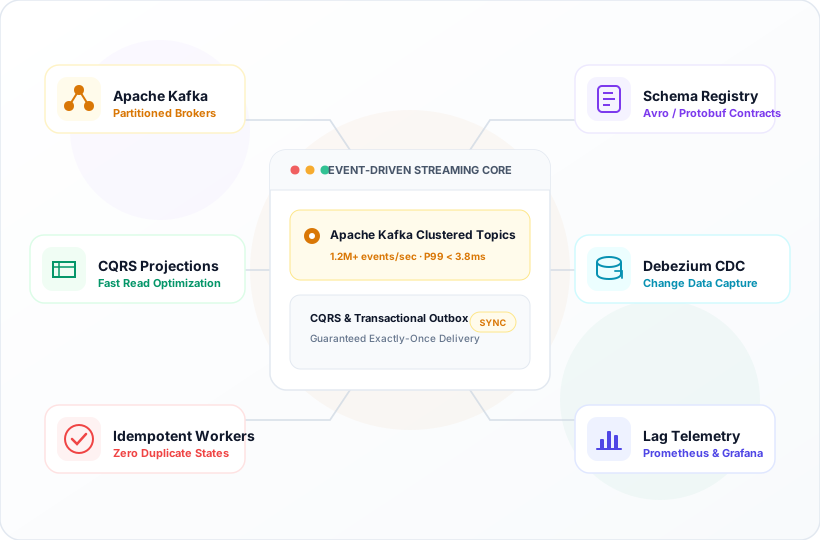
As enterprise software evolves from centralized monoliths to distributed microservices, relying on synchronous HTTP/REST communication introduces cascading latency, tight temporal coupling, and distributed transaction failures. Transitioning to an Event-Driven Architecture (EDA) powered by Apache Kafka, Event Sourcing, and CQRS provides the horizontal throughput and fault isolation necessary for modern scale.
1. The Distributed Monolith Trap: Why Synchronous REST Degrades
When Service A makes a synchronous REST call to Service B, which calls Service C and Service D, the overall latency is additive. Worse, an availability dip or thread exhaustion in Service D cascades backwards, locking connection pools and taking down the entire platform.
The classic attempt to solve this via two-phase commit (2PC) distributed database transactions creates severe lock contention and destroys scalability. Event-driven architecture replaces synchronous commands with immutable domain events published to durable, partitioned commit logs.
2. The Transactional Outbox Pattern: Solving the Dual-Write Dilemma
A ubiquitous pitfall in distributed engineering is updating the database and publishing a message to a broker in the same controller:
If the database transaction commits but the network blips before the message broker acknowledges the event, the event is lost forever. Conversely, if the broker accepts the message but the DB transaction rolls back, downstream services act on phantom data.
The Transactional Outbox Pattern guarantees atomicity. The business entity and the domain event are written to the same relational database in a single local ACID transaction. A Change Data Capture (CDC) agent (like Debezium) or dedicated outbox worker then tails the database write-ahead log (WAL) and streams the event to Kafka reliably.
3. Production Kafka Consumer: Guaranteed Idempotence & Dead-Letter Queues
In distributed systems, the network will inevitably replay messages. Therefore, every consumer must be strictly idempotent:
{
$event = json_decode($record->getValue(), true);
$eventId = $event['event_id'] ?? null;
// 1. Atomic check against processed events ledger (Redis / PostgreSQL)
if (!DB::table('idempotency_keys')->insertOrIgnore(['key' => $eventId, 'created_at' => now()])) {
Log::info("Duplicate event discarded safely: {$eventId}");
return;
}
// 2. Execute business mutation in local transaction
try {
$this->orderService->applyFulfilledStatus($event['order_id'], $event['timestamp']);
} catch (Throwable $e) {
// 3. Route persistent failures to Dead Letter Queue (DLQ) after retry backoff
$this->dlqProducer->send('orders.dlq', $record->getValue(), $e->getMessage());
}
}
4. CQRS: Segregating Read Projections from Command Ingestion
In high-traffic platforms, transactional writes (Orders, Invoices, Billing) require strict normalization and foreign-key constraints. Conversely, dashboard queries and catalog browsing require denormalized, ultra-fast read models:
- Command Side: Writes atomic state events to primary PostgreSQL or Kafka topics.
- Asynchronous Projections: Background microservice consumers subscribe to topics and build optimized read views directly in Redis, Elasticsearch, or Read-Replica Tables.
- Zero Lock Contention: Reporting and search queries never touch the transactional OLTP tables, shielding critical checkout pipelines from complex aggregation locks.
5. Architecture Comparison: Synchronous REST vs. Kafka Streaming
6. Event-Driven Reliability Checklist
- Enforce Schema Governance with Confluent Schema Registry (Avro/Protobuf) to prevent breaking payload changes.
- Set
min.insync.replicas=2andacks=allon critical transactional producers to eliminate message loss. - Monitor Consumer Lag continuously using Prometheus and Grafana alerts before lag surpasses SLA thresholds.
- Implement automated Dead-Letter Queue (DLQ) retry workflows with exponential backoff and jitter.