In an era of distributed multi-cloud workloads, perimeter-only defenses like corporate firewalls and VPN bastions are fundamentally obsolete. Modern enterprise security demands a Zero-Trust Architecture: Never Trust, Always Verify. In this architectural guide, we break down mutual TLS (mTLS) service identities with SPIFFE/SPIRE, dynamic short-lived secrets via HashiCorp Vault, and automated SOC2 Type II compliance controls.
1. Deconstructing Perimeter Defense: Why the Corporate VPN is Dead
Traditional castle-and-moat security assumes that anything inside the internal network boundary is trusted. Once an attacker breaches a single developer laptop, misconfigured S3 bucket, or compromised VPN credential, they gain unfettered lateral movement across internal databases and services.
Zero-Trust treats the internal cloud network as hostile as the public internet. Every single request—whether originating from an external user or between two backend microservices—must be:
- Strongly Authenticated: Cryptographic identity verification before any connection is accepted.
- Contextually Authorized: Granular RBAC and ABAC policies evaluated in real-time.
- End-to-End Encrypted: Complete cryptographic encryption in-transit (mTLS) and at-rest (envelope encryption).
2. Microsegmentation & Mutual TLS with SPIFFE/SPIRE & eBPF Cilium
Hardcoding static API keys or relying on IP whitelisting inside dynamic Kubernetes environments is brittle and insecure. IP addresses are ephemeral and easily spoofed.
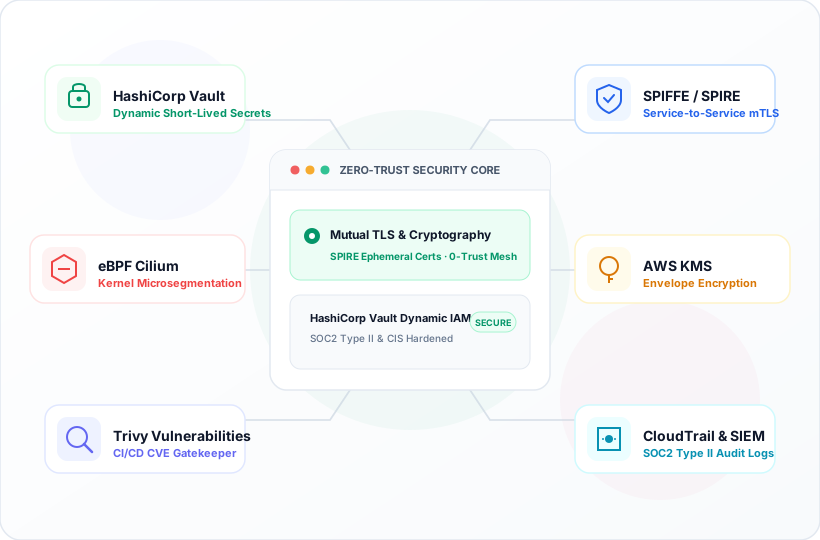
Instead, our production clusters leverage SPIFFE (Secure Production Identity Framework for Everyone) and SPIRE:
- Every container workload is issued an ephemeral, short-lived X.509 SVID certificate automatically rotated every 60 minutes.
- eBPF-Powered Cilium intercepts traffic directly in the Linux kernel, enforcing layer-7 security policies with near-zero CPU context-switching overhead.
- Inter-service communication requires bilateral cryptographic verification (mTLS), making man-in-the-middle sniffing impossible.
3. Dynamic Secrets & Least Privilege with HashiCorp Vault
Static database passwords written in .env files or cloud secrets managers represent high-severity attack vectors. If leaked, they remain valid indefinitely until manually rotated.
With HashiCorp Vault, applications authenticate via Kubernetes Service Account tokens to obtain dynamic, unique database credentials that expire automatically after 4 hours:
capabilities = ["read"]
}
# Dynamic SQL Statement executed upon credential generation
CREATE ROLE "{{name}}" WITH LOGIN ENCRYPTED PASSWORD '{{password}}'
VALID UNTIL '{{expiration}}';
GRANT SELECT, INSERT, UPDATE ON orders TO "{{name}}";
# Automatic revocation cleans up user upon lease expiry
4. Envelope Encryption & Key Governance with AWS KMS
Directly encrypting large files and database columns with Master Keys is slow and exposes root keys. We implement Envelope Encryption:
- A unique, high-entropy Data Encryption Key (DEK) encrypts the plaintext data locally using AES-256-GCM.
- The DEK is encrypted using a non-exportable Key Encryption Key (KEK) residing inside hardware security modules (HSM) in AWS KMS or Google Cloud KMS.
- Only the encrypted DEK is stored alongside the ciphertext, ensuring zero key leakage even if database dumps are compromised.
5. Security Paradigm Comparison Matrix
6. SOC2 Type II & Enterprise Cloud Security Checklist
- Enforce MFA & Single Sign-On (SSO) with FIDO2 hardware security keys for all engineering access.
- Run automated Vulnerability Scanners (Trivy & Grype) in the CI/CD pipeline, blocking deployments with Critical/High CVEs.
- Centralize all cloud infrastructure events in an immutable, append-only SIEM / CloudTrail lake with automated alerting on privilege escalation attempts.
- Conduct continuous Infrastructure-as-Code (IaC) compliance auditing with tfsec and Checkov to catch open security groups before deployment.